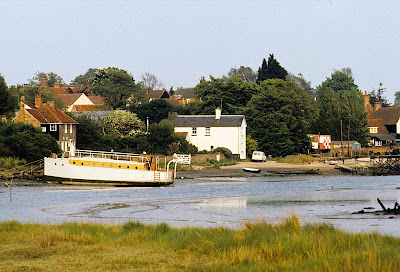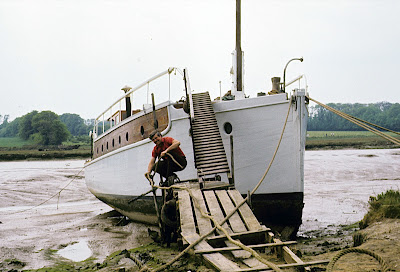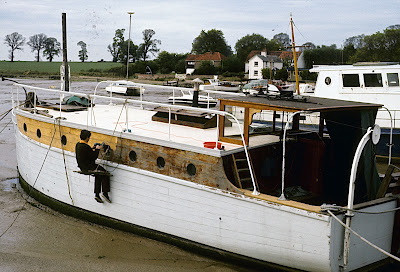
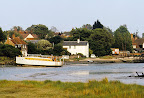
Plain Kate’s journey to Tollesbury: David Hillyer recounts the day in November 1977
At the crack of dawn Brian Medlar and I set out around the wall to the Leaving’s path, where we found our pulling dinghy which got us aboard Ada, our trusty 27’ ex naval whaler, the centre’s safety boat. We chugged out of Tollesbury and into the misty Blackwater Estuary, carefully steering out past the Nass and on to Brightlingsea. Our destination was St Osyth where Plain Kate was to be towed into her new Tollesbury home – it was November 1977.
I’d been to Brightlingsea many times with the fleet, so it was a familiar journey, but only to St Osyth once when Iain Arthur and I sailed back into the Blackwater in their family’s 17’ cruiser Thurra after an epic sail through the Thames Estuary into the Medway River.
It was an early afternoon spring tide, so with the flood under us we started a winding journey along St Osyth Creek. It was a curious experience, with little to see except the banks either side, and then the water opened out revealing St Osyth Boatyard, with Plain Kate tethered to the bank on the port hand. Our hearts started to pound.
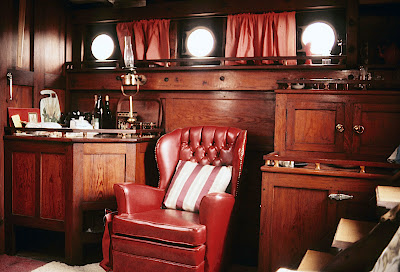
We came alongside, and climbed onboard. The huge key that David Alexander had proudly given to me a few weeks before was turned in the lock of the cabin door which swung open – the smell of polish and sight of gleaming brass struck us both. Brian hadn’t seen the boat, so he quickly leapt inside and explored – his face was a picture.
Our excitement then gave way to the reality of the journey back to Tollesbury. The creek was becoming flooded with the high spring tide, and we needed to be on our way. We began to cast off the less important lines preparing to swing round into the creek. The last line was cast off, and with Brian at Plain Kate’s helm I pulled her out into the creek. We sped along the creek with the ebbing tide beginning to take us, the tow felt very manoeuvrable all pivoting from Ada’s central towing post. Then turning into Brightlingsea Creek – we were on the way to Tollesbury!
Once we’d got out into the estuary we eased off and Brian joined me onboard – she appeared to be very happy to follow with no one at the helm. It was a steady tow back into Tollesbury, taking four hours, and then into the Leavings where we picked up a mooring. We secured everything, and then clambered onboard and into the saloon, where we sat for a short while feeling so pleased with ourselves. We’d done it!
I said to Brian that Margaret would be wondering how we were getting on, she’d be back from school by now. So we gathered our kit and rowed back to the path. We walked quickly back along the wall, enjoying the quiet and the evening sunset. Bursting though the door of the flat, Margaret was waiting to hear the story of Plain Kate’s journey to Tollesbury.
I’d been to Brightlingsea many times with the fleet, so it was a familiar journey, but only to St Osyth once when Iain Arthur and I sailed back into the Blackwater in their family’s 17’ cruiser Thurra after an epic sail through the Thames Estuary into the Medway River.
It was an early afternoon spring tide, so with the flood under us we started a winding journey along St Osyth Creek. It was a curious experience, with little to see except the banks either side, and then the water opened out revealing St Osyth Boatyard, with Plain Kate tethered to the bank on the port hand. Our hearts started to pound.
We came alongside, and climbed onboard. The huge key that David Alexander had proudly given to me a few weeks before was turned in the lock of the cabin door which swung open – the smell of polish and sight of gleaming brass struck us both. Brian hadn’t seen the boat, so he quickly leapt inside and explored – his face was a picture.
Our excitement then gave way to the reality of the journey back to Tollesbury. The creek was becoming flooded with the high spring tide, and we needed to be on our way. We began to cast off the less important lines preparing to swing round into the creek. The last line was cast off, and with Brian at Plain Kate’s helm I pulled her out into the creek. We sped along the creek with the ebbing tide beginning to take us, the tow felt very manoeuvrable all pivoting from Ada’s central towing post. Then turning into Brightlingsea Creek – we were on the way to Tollesbury!
Once we’d got out into the estuary we eased off and Brian joined me onboard – she appeared to be very happy to follow with no one at the helm. It was a steady tow back into Tollesbury, taking four hours, and then into the Leavings where we picked up a mooring. We secured everything, and then clambered onboard and into the saloon, where we sat for a short while feeling so pleased with ourselves. We’d done it!
I said to Brian that Margaret would be wondering how we were getting on, she’d be back from school by now. So we gathered our kit and rowed back to the path. We walked quickly back along the wall, enjoying the quiet and the evening sunset. Bursting though the door of the flat, Margaret was waiting to hear the story of Plain Kate’s journey to Tollesbury.
posted by JCK at 13:08
0 comments